Measurements and fit
How to measure an existing garment
Learn how to take repeatable flat measurements from clothing you already own and compare them with a one-off piece.
Before you begin
- Compare with a garment that fits well and has a similar shape and fabric.
- Lay it flat and smooth it gently without stretching.
- Label each number as a flat width or a full circumference.
Garment measurements can be more useful than relying on a size label alone. Two garments marked with the same size may fit differently because of their cut, fabric, age and intended ease.
When considering a one-off piece, compare its listed garment measurements with a similar item that already fits you well. These are measurements of the clothing—not body measurements—and they should not be treated as a guarantee of fit.
What you will need
- A flexible tape measure.
- A flat, firm surface.
- The garment fastened as it would normally be worn.
- A note on whether the fabric stretches.
Use centimetres throughout and measure to the nearest sensible increment. Pull the fabric smooth without stretching it.
Start with a suitable comparison garment
Choose an item with a similar purpose and shape. A fitted woven shirt is a better comparison for another fitted woven shirt than an oversized stretch T-shirt.
Wash or settle the garment as you normally would before measuring. Lay it flat, remove items from pockets, close zips and buttons, and align obvious seams without forcing them.
Common flat measurements
Chest or bust
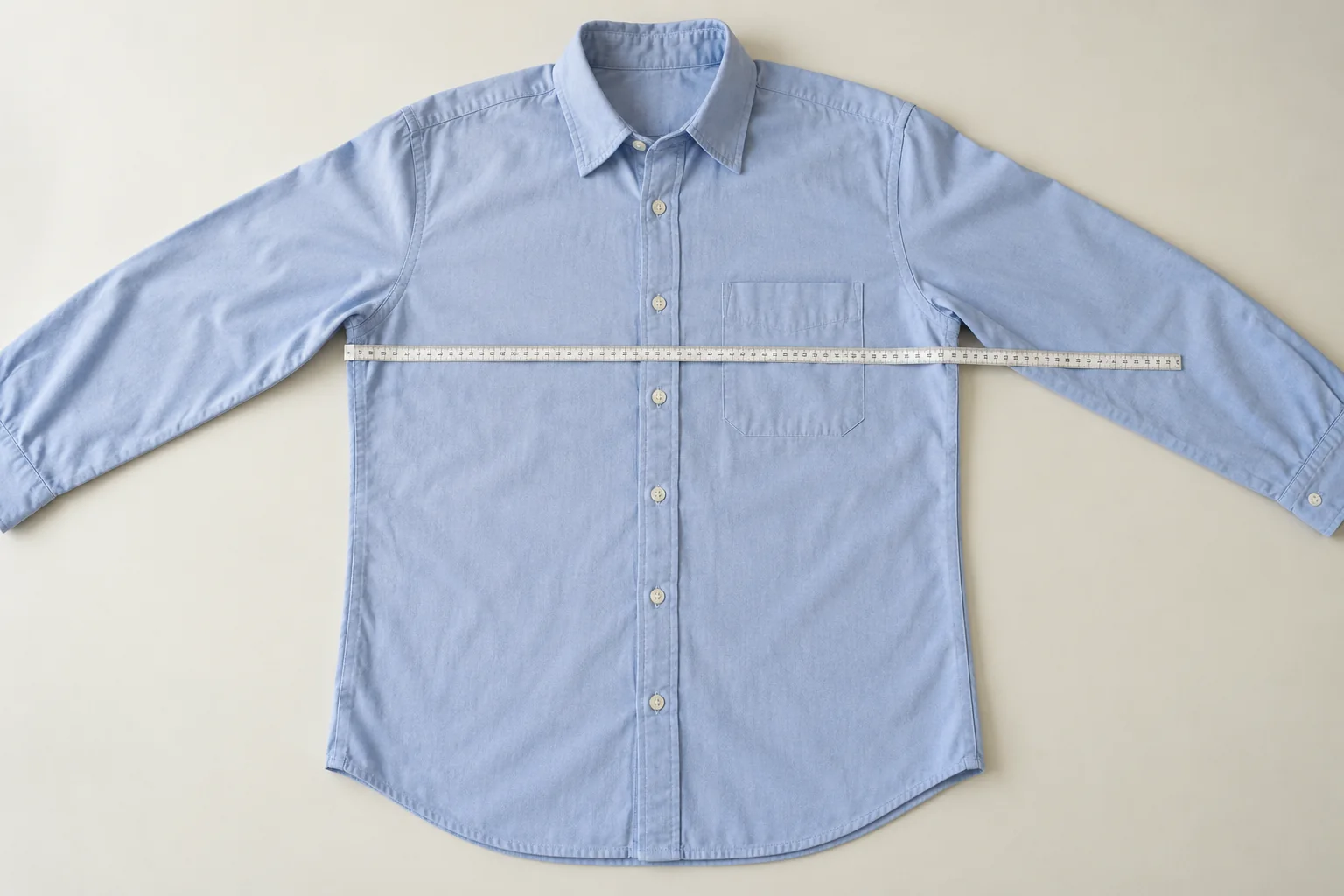
Measure straight across from underarm seam to underarm seam. This flat measurement is often doubled to describe the full garment circumference, but check how the seller has defined it.
For example, a 50 cm flat chest width is approximately 100 cm around the garment when doubling is appropriate. Neither number is a body measurement. Do not double sleeve length, overall length, rise or inseam.
For shaped, asymmetric or darted garments, a flat width may not describe the full circumference accurately. Ask for the seller’s method and compare like with like.
Waist
Measure across the garment at its natural waist position or waistband. For an elastic waist, record the relaxed measurement and, if useful, a comfortable stretched measurement without pulling to the absolute limit.
Hips
Measure across the widest part of the garment below the waist. The exact position varies with the style, so note how far below the waist you measured.
Garment length
For tops and dresses, measure from the nominated shoulder point down to the hem. For skirts, measure from the top of the waistband to the hem. Record where you started because different sellers may use different reference points.
Sleeve length
Measure from the shoulder seam to the end of the cuff. For a raglan sleeve, a neck-to-cuff measurement may be more useful because there is no conventional shoulder seam.
Shoulder width
Measure across the back from one shoulder seam to the other. This is most useful on garments with a clearly defined shoulder.
Trouser rise and inseam
For the front rise, measure from the top of the front waistband to the crotch seam. For the inseam, measure from the crotch seam to the hem along the inside leg.
Measure twice
Small differences can come from a twisted seam, uneven surface or a tape held at an angle. Repeat each measurement and write down the method you used.
If a listing gives a measurement that seems ambiguous, ask how it was taken rather than making an assumption.
Use this short recording format:
- Item and fabric: for example, a non-stretch woven shirt.
- Chest: ___ cm flat, underarm to underarm.
- Waist: ___ cm flat, measured ___ cm below the underarm.
- Length: ___ cm, from ___ to the hem.
- Sleeve: ___ cm, from ___ to the cuff.
- Notes: relaxed or stretched; buttons fastened; any unusual measuring points.
Allow for ease and fabric behaviour
A garment generally needs some difference between its measurements and your body measurements so you can move, sit and breathe. The amount depends on the style: a loose overshirt behaves differently from a fitted bodice.
Stretch fabric may accommodate the body differently from non-stretch woven fabric. A measurement alone cannot describe recovery, drape, lining, seam placement or comfort.
Use measurements as evidence, not a promise
Comparing a well-fitting garment can reduce uncertainty, but it cannot guarantee identical fit. Pattern shape, shoulder angle, body proportions, fabric and construction all matter.
For one-off pieces, Etsy remains the source of truth for current listing measurements, availability, price, shipping and purchase terms. Ask questions before buying if an important measurement is missing.
Further reading
Simplicity’s pattern guide recommends measuring clothes you already like wearing to understand finished garment measurements and ease.